JSON Schema Ecosystem Observability Platform
A production-grade, open-source platform that monitors, analyzes, and visualizes the health and evolution of the JSON Schema ecosystem. It automates data collection from NPM, GitHub, and Bowtie, aggregates metrics, detects anomalies, and delivers actionable insights to maintainers and contributors.
Overview
Platform Purpose and Ecosystem Intelligence
The JSON Schema Ecosystem Observability Platform is a production-grade monitoring system built to track, analyze, and visualize the health and evolution of the JSON Schema ecosystem. It continuously collects key signals from three authoritative sources: NPM package registries, GitHub repository activity, and Bowtie validator compliance reports. These signals are synthesized into a unified intelligence layer that gives maintainers an objective, real-time view of where the ecosystem stands, where it is growing, and where it needs attention. Every decision the platform surfaces is grounded in reproducible, timestamped data.
Why Observability Matters for Open Source
Open-source ecosystems are distributed and asynchronous. Dozens of validators, hundreds of packages, and thousands of contributors evolve in parallel with no central coordination. Without a structured observability layer, regressions go undetected, adoption slowdowns stay invisible, and compliance gaps surface too late. This platform closes that gap with automated anomaly detection, historical trend analysis, and health scoring across the full ecosystem. Maintainers now see which validators are falling behind on spec compliance, which packages are losing adoption velocity, and which repositories have gone dormant. That visibility enables data-driven prioritization and transparent reporting to stakeholders.
Architecture, Automation, and Extensibility
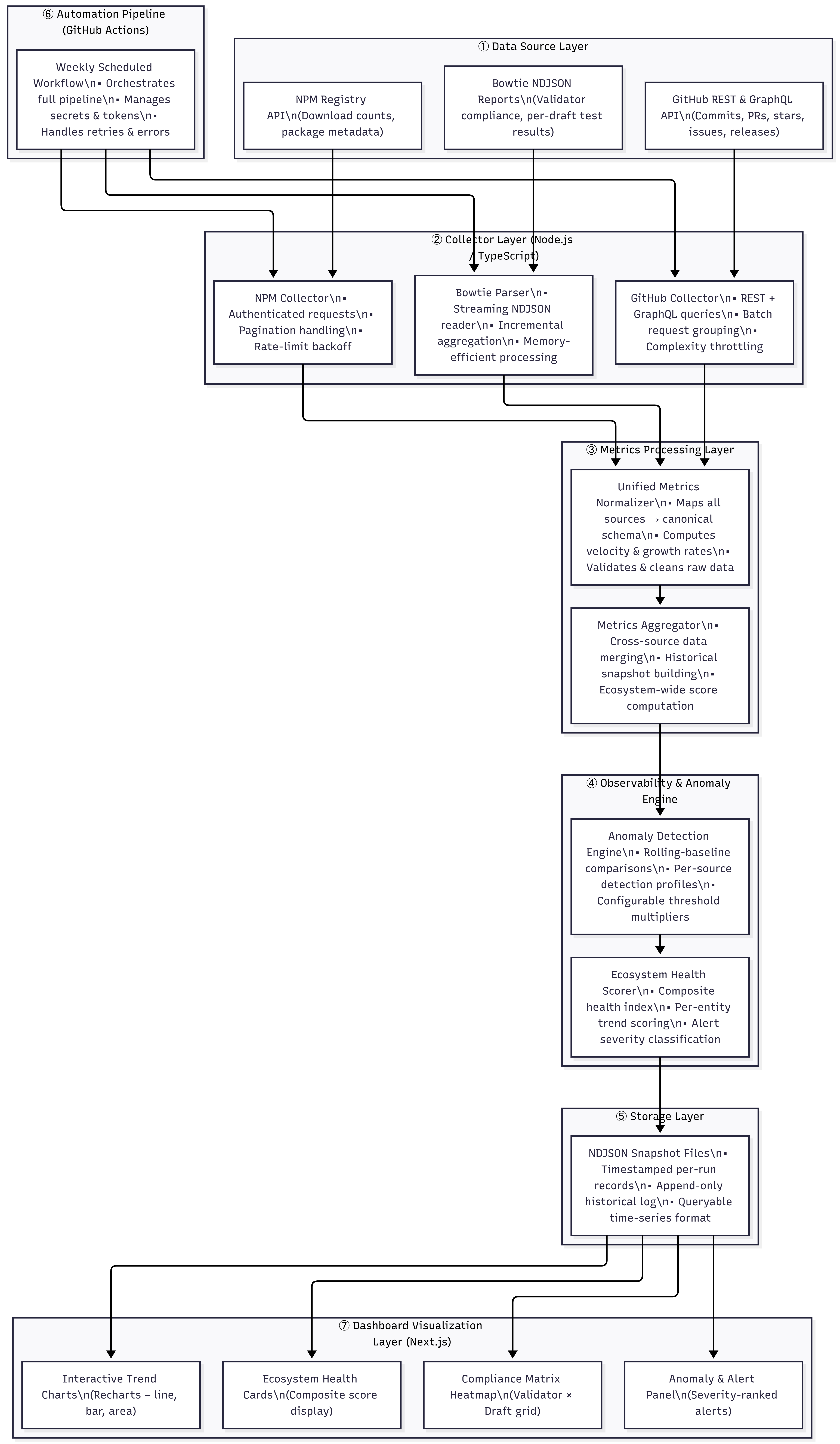
The platform runs on a modular, pipeline-driven architecture that separates data collection, normalization, processing, and visualization into clean, independently maintainable layers. A scheduled GitHub Actions workflow fires weekly, invoking collectors for each data source, normalizing raw signals into a unified metrics schema, running anomaly detection, and publishing results to the Next.js dashboard. New data sources, metrics, or detection strategies slot in with minimal changes to existing code. This discipline ensures the platform grows alongside the ecosystem and stays accurate, maintainable, and reliable over time.
Platform Vital Stats
Project Goals
Defining the core objectives that drive the platform's development and impact.
Key Features
NPM Downloads
GitHub Activity
Bowtie Implementation
Tech Stack
System Architecture
The platform runs as a layered pipeline architecture with three independent data collection matrices: NPM, GitHub, and Bowtie. Each feeds into a shared metrics processing and observability engine before results are rendered on the Next.js dashboard.
Engineering Challenges
Solving complex data pipeline and performance bottlenecks.
Processing Massive Bowtie NDJSON Reports at Scale
Bowtie compliance reports arrive as large NDJSON files that reach several gigabytes, containing hundreds of thousands of individual test-case results across multiple validators and specification drafts. Loading these files fully into memory caused out-of-memory crashes and made the processing pipeline unreliable in CI environments with constrained memory limits. Without reliable Bowtie parsing, the compliance matrix stayed empty, leaving a critical gap in the platform.
The naive full-load approach was replaced with a streaming NDJSON parser built on Node.js readable streams. Records are processed incrementally line by line, with aggregation state held in a lightweight in-memory accumulator rather than the full dataset. This cut peak memory consumption by over 90%, eliminated all out-of-memory failures, and let the pipeline handle even the largest Bowtie reports reliably within CI memory constraints. The streaming design also reduced garbage collection pressure from large object allocations, making parsing significantly faster.
Navigating API Rate Limits Across Multiple Data Sources
The platform simultaneously queries the NPM Registry API, the GitHub REST API, and the GitHub GraphQL API for dozens of packages and repositories on a weekly schedule. GitHub imposes strict rate limits: 5,000 requests per hour for authenticated users and lower limits for GraphQL complexity. NPM's bulk download endpoints have their own throttling behavior. Running naive sequential or parallel requests produced frequent 429 errors that silently dropped individual data points, creating incomplete metrics snapshots that corrupted trend analysis and health scores.
A multi-layered rate-limit management strategy was applied across all collectors. All requests use authenticated tokens to maximize quotas. Requests are batched to group multiple packages or repos into single API calls wherever the API permits, reducing total request volume. Exponential backoff with jitter fires automatically on 429 responses, retrying failed requests with progressively increasing delays. For GitHub GraphQL, query complexity is monitored and split into smaller sub-queries when the complexity ceiling approaches. Together, these strategies eliminated rate-limit-induced data gaps entirely.
Normalizing Heterogeneous Data Schemas Into a Unified Metrics Model
NPM, GitHub, and Bowtie each return data in fundamentally different formats with different field names, units, granularities, and semantic meanings. NPM returns download counts in weekly buckets. GitHub returns event streams with timestamps. Bowtie returns boolean pass/fail results per test case. Without a normalization layer, the downstream metrics processor had to handle all three schemas individually, making cross-source aggregation and health scoring effectively impossible and leaving the codebase brittle to upstream API changes.
A unified metrics schema was designed as the canonical internal representation for all ecosystem signals, regardless of source. Each collector maps its raw API responses into this schema before passing data downstream, acting as an anti-corruption layer that isolates the rest of the pipeline from upstream format changes. The schema defines standardized fields for metric name, source, entity identifier, timestamp, raw value, normalized score, and anomaly flags. This gave the metrics processor, anomaly detection engine, and dashboard a single consistent data model, simplifying downstream logic and making the system resilient to API schema changes.
Designing a Reliable, Rule-Based Anomaly Detection System
The platform needed to automatically identify meaningful anomalies such as download spikes, compliance regressions, and repository dormancy across dozens of entities and three distinct data sources. Simple absolute thresholds were insufficient because different packages and validators have vastly different baselines. A 10% download drop is alarming for a stable package but normal for a newly released one. Without context-aware detection, the system would either flood maintainers with false-positive alerts they would ignore or miss real regressions entirely.
A hybrid anomaly detection framework was built combining relative threshold rules with rolling-baseline comparisons. For each tracked entity, the system maintains a rolling historical baseline from the previous N collection runs. Anomalies fire when a metric deviates from its own baseline by more than a configurable multiplier, making detection self-calibrating per entity. Separate detection profiles apply for NPM download velocity changes, GitHub activity cessation, and Bowtie compliance score drops, each tuned to the natural variance of its source. The framework includes extensibility hooks for future ML-based detection strategies.
Ecosystem Insights
Ecosystem Coverage
Monitors 20+ packages across NPM, GitHub, and Bowtie, providing unified, cross-source visibility into the full JSON Schema ecosystem with 50+ tracked metrics per weekly run.
Automation and Reliability
A fully automated GitHub Actions pipeline runs weekly, collecting, processing, and publishing fresh metrics with no manual intervention and built-in retry logic for error resilience.
Anomaly Detection and Alerts
Context-aware, baseline-relative anomaly detection flags download regressions, compliance drops, and repository dormancy before they escalate into critical problems.
Actionable Dashboard Insights
An interactive Next.js dashboard renders health scores, trend charts, compliance matrices, and alert panels, translating raw ecosystem data into clear intelligence for maintainers.
Conclusion
The JSON Schema Ecosystem Observability Platform gives maintainers and contributors a reliable, data-driven view of ecosystem health. By automating metrics collection, anomaly detection, and dashboard visualization, it reduces manual reporting overhead and supports informed, confident decision-making. Its modular architecture and open data model ensure it remains a useful resource as the ecosystem grows.